
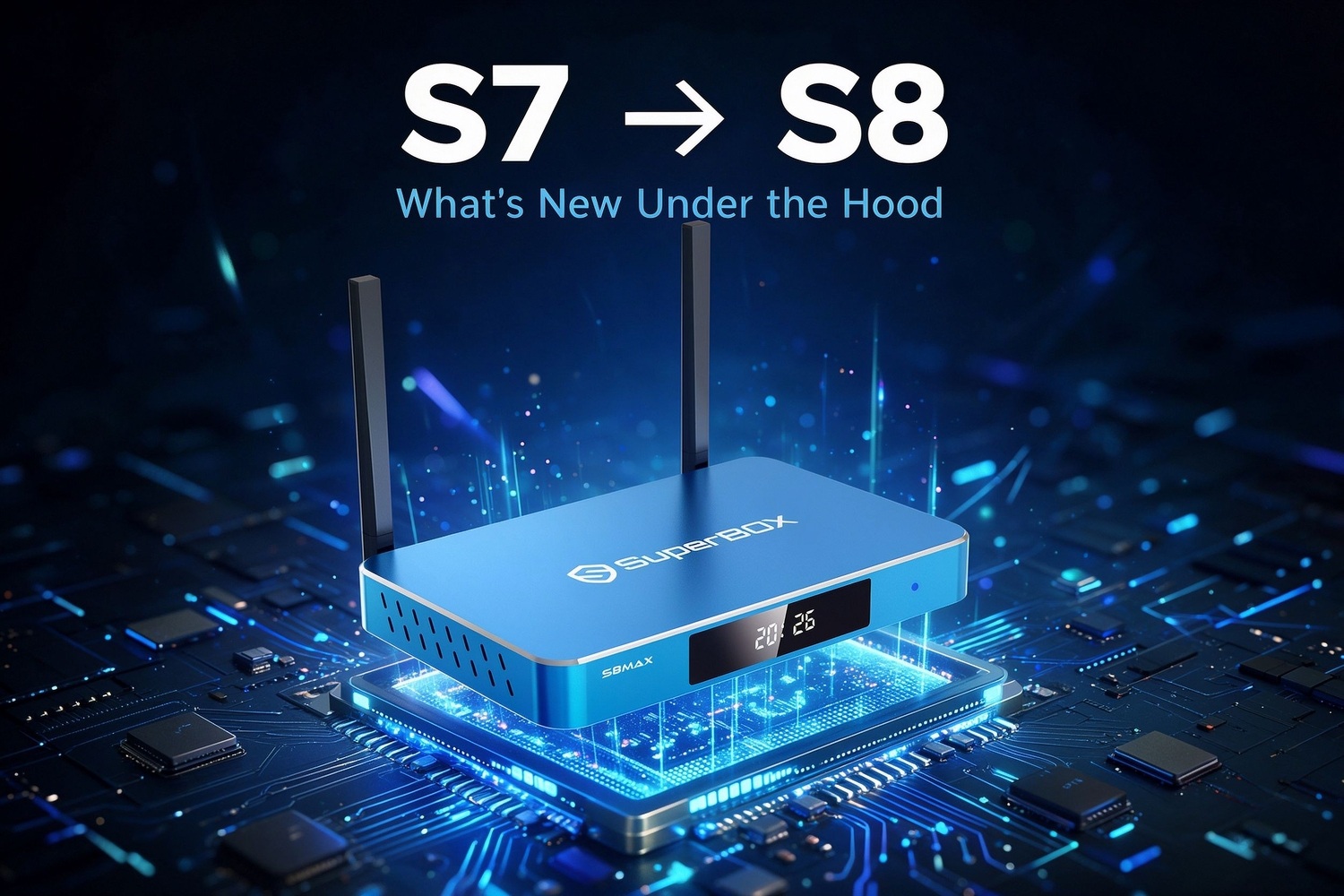
Product launches tend to be heavy on buzzwords and light on specifics. This article takes the opposite approach: a ground-level look at what actually changed between the SuperBox S7 and S8 generations, and what those changes mean in practice.
The Interface: A Full Redesign
The S8 ships with a completely redesigned home screen. This is not a cosmetic reskin — the navigation structure, card layout, and shortcut system have all been reworked. The left-hand rail now provides faster access to core functions, and the content cards are larger and more readable.
Underneath, the launcher has been optimized for faster cold starts and smoother scrolling. Side-by-side with an S7, the S8 interface feels noticeably more responsive, particularly when waking the device from standby.
Playback Engine: The "3X Stable" Claim
SuperBox describes the S8 playback engine as "3X stable," which is not a measurable specification but refers to three specific improvements:
- Buffer management — the S8 uses a larger and more intelligent buffer, reducing mid-playback stalls on variable connections.
- App isolation — a misbehaving app is less likely to crash the entire system or force a return to the home screen.
- Memory management — background apps are terminated more aggressively, keeping foreground playback smooth even with many apps installed.
The result is a device that requires less rebooting and recovers more gracefully from network hiccups.
Multi-View Architecture
The S7 introduced multi-view on higher-end models, but the S8 rearchitects it. The key change is that multi-view is now available across the entire S8 lineup (limited on Pro/Plus, full on Max/Ultra), whereas on the S7 it was restricted to specific models and app types.
The full multi-view on the SuperBox S8 Max and Ultra supports more simultaneous sources and a more flexible layout system. For a hands-on walkthrough, check our multi-view setup guide. This was made possible by additional memory allocation for the multi-view compositor, a change that would not have been feasible on the S7's older software stack.
Built-In Recording
Recording on the S7 was functional but limited — it could be finicky about which apps could be captured and how recordings were managed. The S8 standardizes recording across all models and introduces a unified recording library with thumbnail previews and easier deletion. Recordings are also more resilient to system interruptions.
Storage Tiering
The S8 lineup uses a more granular storage strategy:
| Model | S7 Storage | S8 Storage |
|---|---|---|
| Pro | 32GB | 32GB |
| Plus | — | 64GB (new tier) |
| Max | 64GB | 64GB |
| Ultra | 128GB | 128GB |
The addition of the S8 Plus as a dedicated 64GB mid-range model is the most significant change. Previously, buyers had to choose between 32GB and 64GB with a larger price gap. The S8 Plus fills that gap more affordably.
Ports: The S8 Plus Anomaly
Most S8 models use USB-C for power and data, consistent with the S7's direction. The SuperBox S8 Plus is the exception: it uses a round DC power plug and dual USB-A ports. This is likely a cost-control measure to keep the Plus at a lower price point while still offering 64GB storage. For end users, it means the S8 Plus is the only S8 model that cannot be powered by a standard USB-C cable.
AI Upscaling: S8 Ultra Exclusive
The S8 Ultra introduces AI upscaling, a feature entirely absent from the S7 lineup. This uses on-device neural processing to analyze each frame and enhance edges, detail, and contrast in real time. It is most visible on 1080p or lower-resolution media displayed on 4K displays.
What Did Not Change
For all the improvements, several specs carry over unchanged: 4GB RAM across all models, 6K@60fps video decoding, Android 12, WiFi 6, Gigabit Ethernet, voice command, 7-day time shift, and parental controls. The S8 is an evolution, not a revolution.
Final Assessment
The S8 generation's real improvements are in software experience — interface, stability, multi-view, and recording — rather than raw hardware specs. For users who interact with the device daily, these are exactly the changes that matter most. For casual users who only launch one app and let it play, the S7 remains perfectly adequate.